It's Time to Get WISE.
 15-Minute Consultation
A quick, honest call to assess your needs and point you in the right direction—no sales pitch. Best suited for:
- Established businesses with a defined marketing budget
- Businesses prepared to grow and scale
 60-Minute Strategy Session
A deep dive with a top expert to uncover gaps and map a smarter path forward.
- Includes a $250 digital audit covering your website, SEO, local presence, and online performance—yours to keep.
- Get smart, actionable ideas you can apply to your business right away.

Enter the email you would like your guide sent to:

Enter the email you would like your guide sent to:

Enter the email you would like your guide sent to:
Apply Today
Please fill out the information below. Someone on our team will reach out in 3-5 business days to schedule a call if we see a good fit.
Book Patrick Dillon
Thanks for your interest in booking WISE CEO Patrick Dillon on your podcast! Please complete the form below, and a team member will contact you shortly.

Remove Negative Reviews.
Top Digital Marketing Strategies for Professional Firms 2026


December 16, 2025
- 11 min read

Digital client acquisition has undergone a fundamental transformation. While 2024 was a year of experimentation with artificial intelligence, 2025 served as the tipping point for consumer behavior change. As we look toward 2026, the way high-net-worth individuals and corporate decision-makers find professional services has shifted from simple "searching" to complex "vetting" via AI.
For partners, principals, and marketing directors at lawfirms, CPA firms, wealth management groups, mortgage companies, and more, the strategy is no longer just about ranking first on Google. It is about being the cited authority in the answers provided by the world’s new gatekeepers: ChatGPT, Gemini, and Perplexity.
The Core Thesis for 2026: Success in the coming year requires a Hybrid Marketing Model. Firms must maintain dominance in traditional SEO and PPC for immediate visibility while aggressively implementing Generative Engine Optimization (GEO) to secure recommendations from AI Answer Engines.
Introduction: The Seismic Shift in Consumer Behavior
For two decades, the "search" paradigm was linear: a user typed a query like "estate planning attorney near me," browsed 10 blue links, and clicked the one that looked most promising.
Today, that linearity is fractured. High-value prospects—those seeking complex tax advice, high-stakes litigation support, or jumbo mortgage financing—are bypassing the "10 blue links." They are conversing with AI models. They are asking specific, nuanced questions: "Who is the best tax attorney in Chicago for international inheritance disputes?" or "Compare the top three mortgage brokers in Beverly Hills based on recent client reviews."
This is not a future prediction; it is the current reality. The shift is not just technological; it is behavioral. Prospective clients want synthesized answers, not a list of homework. If your firm is not positioned to be the answer, you are invisible to a rapidly growing segment of the market, and according to our partners, it is the best segment of the market.
The WISE Perspective
At WISE Digital Partners, we have spent more than a decade navigating the digital evolution for professional services. Backed by a team of experts I’ve spent years assembling, our philosophy is simple. We don’t chase trends. We stay transparent, move with data, and focus on one thing above all else. ROI.
Our analysis of client data across the legal, financial, and lending sectors indicates that "AI-Integrated" marketing is no longer optional. It is the differentiator between firms that will scale in 2026 and those that will stagnate.
The Rise of Generative Engine Optimization (GEO)
To capitalize on this behavioral shift, firms must adopt Generative Engine Optimization (GEO). While traditional SEO focuses on ranking a webpage, GEO focuses on ranking information. It is the art and science of optimizing content to maximize the likelihood that Large Language Models (LLMs) like ChatGPT, Claude, and Gemini will recognize your firm as a primary authority and cite you in their responses.
Defining GEO for Professional Services
GEO requires a departure from keyword density and a move toward entity establishment. AI models function as "Answer Engines." They scour the web to synthesize a coherent response based on consensus, authority, and sentiment.
How does ChatGPT find local lawyers?
When a user asks an AI for a recommendation, the model does not "search" in the traditional sense. It retrieves information based on specific vectors. To be recommended, a law firm must satisfy the following criteria:
- Digital Footprint Consistency: The firm’s name, address, and practice areas must be identical across all major legal directories (Avvo, Martindale-Hubbell, Google Business Profile, and many more).
- Sentiment Analysis: AI analyzes the text of reviews, not just the star rating. It looks for keywords like "responsive," "won the case," or "expert in complex litigation."
- Brand Mentions and Co-Citation: AI looks for the firm’s name appearing alongside other authoritative entities (e.g., local bar associations, news outlets, or industry awards).
- Structured Data: The firm’s website must use advanced Schema markup to explicitly tell AI, "We are a Personal Injury Firm located in Dallas."
Real-World Proof: The Mortgage Case Study
The impact of GEO is best illustrated by data. Consider a recent case study from one of our clients, a boutique mortgage broker based in Beverly Hills.
In late 2025, we noticed a distinct traffic source anomaly. A lead came through the intake form citing "ChatGPT" as the referral source. This was not a generic inquiry. It was a foreign buyer looking for a specific jumbo loan product for a luxury property.
The Result:
- Transaction: The lead resulted in a closed $7.5M loan.
- The Path: The buyer asked ChatGPT to "Find a mortgage broker in California who specializes in foreign national loans with complex income structures."
- The Optimization: Because WISE optimized the client’s site with deep-dive content regarding "foreign national financing," ChatGPT synthesized that data and presented the client as the top recommendation.
In just a few months into our partnership, this brokerage started receiving 3-5 high-quality AI-generated leads per week. These leads convert at a significantly higher rate than standard PPC traffic because AI has already "vetted" the professional for them.
The Renaissance of Organic SEO for Law and Finance
With the hype surrounding AI, some marketers have prematurely declared the death of SEO. This is a dangerous misconception. In 2026, Organic SEO for financial firms and law practices is more critical than ever, but its role has changed.
SEO Fuels AI
AI models do not generate knowledge from thin air; they are trained on a mix of licensed data, publicly available web data, and sometimes proprietary datasets. If your website does not rank well in traditional search, it is unlikely to be part of AI's training data or its real-time retrieval set (RAG: Retrieval-Augmented Generation).
What is the difference between SEO and GEO for professional firms?
While the two strategies overlap, their objectives and metrics differ significantly:
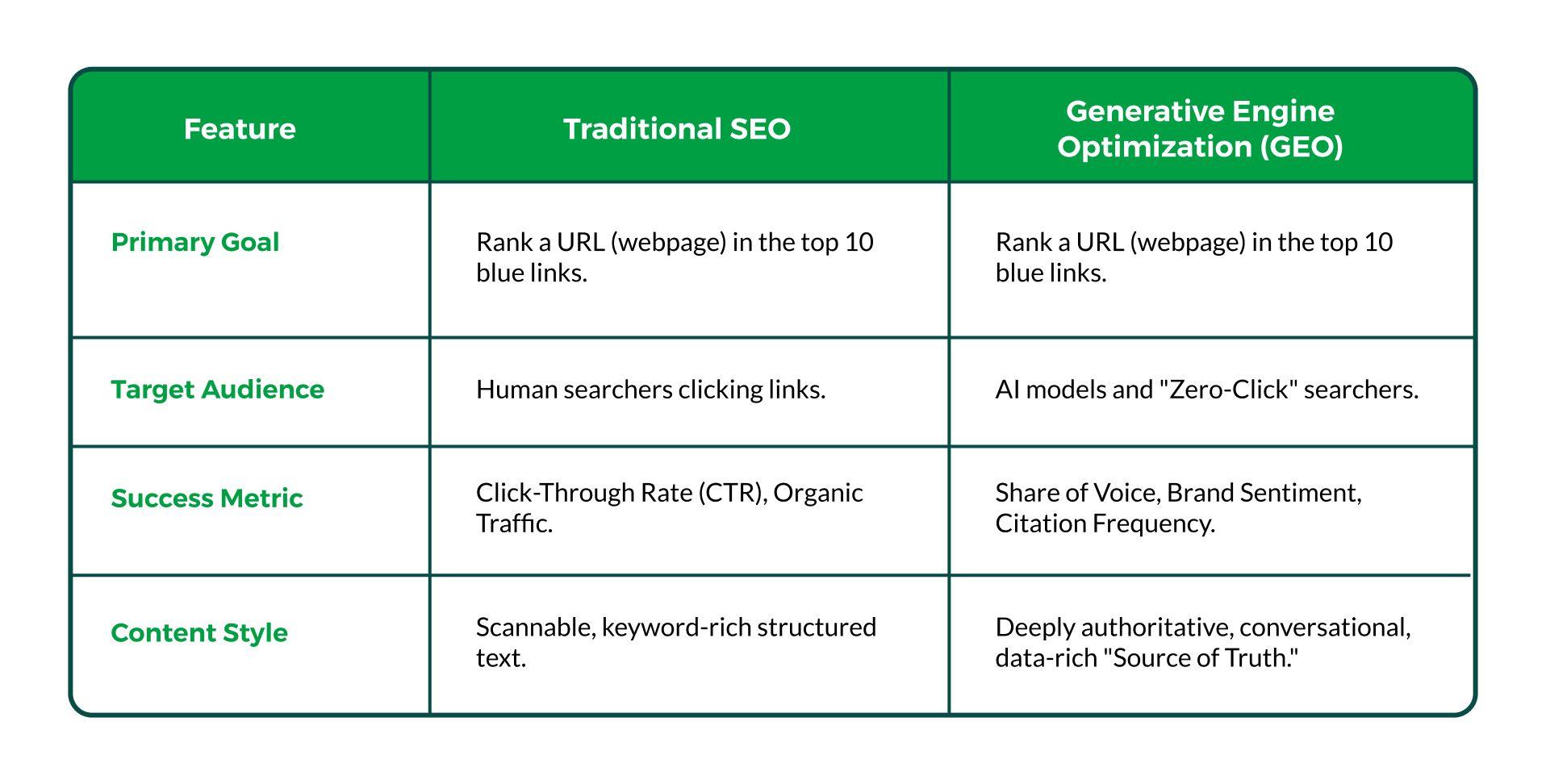
SEO for financial firms provides the foundational "fuel" that powers AI. Without a robust organic presence, your firm effectively does not exist in the digital memory of the Answer Engine.
The Economics of Organic vs. Paid
The renaissance of SEO is also driven by economics. The cost of paid media is skyrocketing.
Client Example: We worked with a mid-sized personal injury law firm that heavily relied on Local Services Ads (LSAs) and PPC. By 2025, the Cost Per Acquisition (CPA) for paid leads had increased by 40% year-over-year due to market saturation.
In response, WISE pivoted the budget. We reallocated 30% of the paid media spend into aggressive content development, technical SEO and GEO. The result was a stabilization of lead volume and a drastic reduction in blended CPA. The organic content continues to generate leads indefinitely without the "pay-to-play" tax of Google Ads.
The Hybrid Model: Integrating PPC, LSA, and Content
While organic strategies build long-term equity, professional services lead generation still requires immediate velocity. The winning strategy for 2026 is a Hybrid Marketing Model.
Synergy of Channels
Siloed marketing fails. Your PPC data should inform your SEO content, and your high-performing SEO pages should be used as landing pages for paid ads.
Is PPC still effective for accounting firms in 2026?
Yes, but only when used strategically. For general queries like "CPA near me," PPC is often too expensive and low-intent. However, for high-intent, urgent queries—such as "IRS audit defense attorney" or "emergency tax filing extension"—PPC remains highly effective.
The Hybrid Model works as follows:
- PPC/LSA: Captures immediate, high-intent demand (The "Now" Business).
- SEO: Captures research-phase traffic and builds domain authority (The "Future" Business).
- GEO: Captures the vetting and conversational search traffic (The "Trust" Business).
Case Study: Multi-Location Accounting Firm
WISE partnered with a multi-location accounting and advisory firm to launch a new website and a hybrid acquisition strategy.
The Strategy:
- Paid: Targeted LSA campaigns for tax season urgency.
- Organic/GEO: Created massive "Hub and Spoke" content clusters around specific industry verticals (e.g., "Accounting for Dentists," "CPA for Real Estate Investors").
The Data:
- Lead Volume: The firm now generates 100+ qualified leads per month from digital (up from 10-20 leads a month before WISE).
- Quality: The sales team reports a 46% qualification/sold rate on these leads (up from 15% prior to WISE).
- Transparency: Because we track the source, the client knows exactly which leads came from the "Accounting for Dentists" content cluster (Organic) versus the "Tax Prep" ads (Paid).
Data, ROI, and Attribution in 2026
The most significant current challenge in GEO strategy is attribution. When a user asks ChatGPT or Perplexity for a recommendation, there is no "click" to track in Google Analytics 4 (GA4) until the user decides to visit your site—and even then, it often appears as "Direct" traffic.
The Attribution Challenge
Marketing Directors must accept that "perfect" digital tracking is a relic of the past. The "Dark Funnel"—where AI conversations happen—is opaque.
How to measure ROI from AI search leads?
To bridge this gap, firms must move beyond software-based attribution and embrace "Self-Reported Attribution."
- Update Intake Forms: Every contact form must include a required field: "How did you hear about us?" with specific options including "ChatGPT/AI Search," "Google Search," and "Clutch/Review Site."
- Sales Scripting: Intake specialists must be trained to ask, "Did you read about us online or did an AI recommend us?"
- Correlative Analytics: Look for correlations between a rise in "Direct Traffic" and your GEO efforts. If you launch a GEO campaign in March and Direct Traffic spikes in April, there is a strong correlation.
Proof of Volume
For one of our large accounting clients, we implemented rigorous self-reported attribution. The data was startling. By Q4 of 2025, nearly 30% of new business revenue was attributed to AI platforms and "word of mouth" that originated digitally.
Without updating their analytics approach, this firm would have mistakenly attributed this revenue to "Direct" traffic or "Unknown," potentially leading them to cut the very budget that was driving their growth.
Content Authority: Writing for Experts, Not Algorithms
To succeed in AI lead generation for lawyers and financial pros, the era of "fluff" content is over.
In 2020, a 500-word blog post defining "What is a Tort?" might have ranked. In 2026, AI models can define a tort in milliseconds. They do not need your basic definitions. They need your expertise.
Depth Over Breadth
For wealth planners and CPA firms, content must demonstrate E-E-A-T (Experience, Expertise, Authoritativeness, and Trustworthiness) at a granular level.
- Don't Write: "5 Tips for Saving on Taxes." (AI can generate this).
- Do Write: "Analyzing the Impact of the 2026 Capital Gains Adjustment on Irrevocable Trusts in California." (This requires human expertise).
LLMs prioritize content that contains unique data, contrarian viewpoints, and deep technical analysis. If your content looks like it was written by an AI, AI will ignore it. To be cited as a source of truth, you must provide insights that AI does not yet possess.
The 2026 Blueprint for Digital Marketing Success
The digital marketing environment for professional services has evolved from a game of keywords to a battle for authority. The firms that win in 2026 will be those that recognize AI not just as a tool for efficiency, but as the primary gatekeeper of new business.
To navigate this landscape, your firm must prioritize three pillars:
- Technical SEO & Content Depth: Building the infrastructure and "Source of Truth" content that feeds the algorithms.
- Generative Engine Optimization (GEO): Structuring your brand entity to be the recommended "answer" for high-net-worth inquiries.
- Strategic Paid Media: Using PPC and LSAs for velocity and high-intent capture while organic equity builds.
The shift is here. The data is clear. The only question remaining is whether your firm will be the answer the market is looking for.
Is your firm ready for AI-driven search? Partner with a team that understands the intersection of data, strategy, and professional services.
Schedule a Strategy Session with WISE Digital Partners Let’s build your 2026 roadmap today.
Share
Subscribe to WISE Insights
Stay ahead of the digital marketing curve and never miss a lucrative trend or insightful tidbit – subscribe to our WISE blog!
Keep Reading




Build. Grow. Soar.
Get WISE about digital marketing with advanced services, industry experts, and cutting-edge tools designed for long-term, sustainable growth.