It's Time to Get WISE.
 15-Minute Consultation
A quick, honest call to assess your needs and point you in the right direction—no sales pitch. Best suited for:
- Established businesses with a defined marketing budget
- Businesses prepared to grow and scale
 60-Minute Strategy Session
A deep dive with a top expert to uncover gaps and map a smarter path forward.
- Includes a $250 digital audit covering your website, SEO, local presence, and online performance—yours to keep.
- Get smart, actionable ideas you can apply to your business right away.

Enter the email you would like your guide sent to:

Enter the email you would like your guide sent to:

Enter the email you would like your guide sent to:
Apply Today
Please fill out the information below. Someone on our team will reach out in 3-5 business days to schedule a call if we see a good fit.
Book Patrick Dillon
Thanks for your interest in booking WISE CEO Patrick Dillon on your podcast! Please complete the form below, and a team member will contact you shortly.

Remove Negative Reviews.



Someone has probably asked whether ChatGPT recommends your firm by name. An agency could run a visibility scan and send over a score. Maybe you tried it yourself, asked for the best firm like yours in your city, and never saw your name come back. That is worth checking. It is also the smallest part of what is actually happening.
Before anyone asks AI who to hire, they ask whether they have a problem worth hiring someone to fix. Then they ask what fixing it would involve. Only then do they ask who the right hire is.
So when you type "best accounting firm near me" into ChatGPT and hope to see your own name, you are competing in the most crowded space in your market. Every firm wants to show up there. It is also the smallest slice of the decision.
Generative engine optimization (GEO) is the whole discipline of earning visibility inside AI answers. Your prospects are asking a lot of questions, and if you're starting from nothing, which most businesses are, the ones everyone is selling you are the hardest of the three to win.
The Three Kinds of Questions Every Prospect Asks
Every engagement you have won started with someone who did not yet know they needed you. Between that moment and a signed agreement, they moved through three kinds of questions.
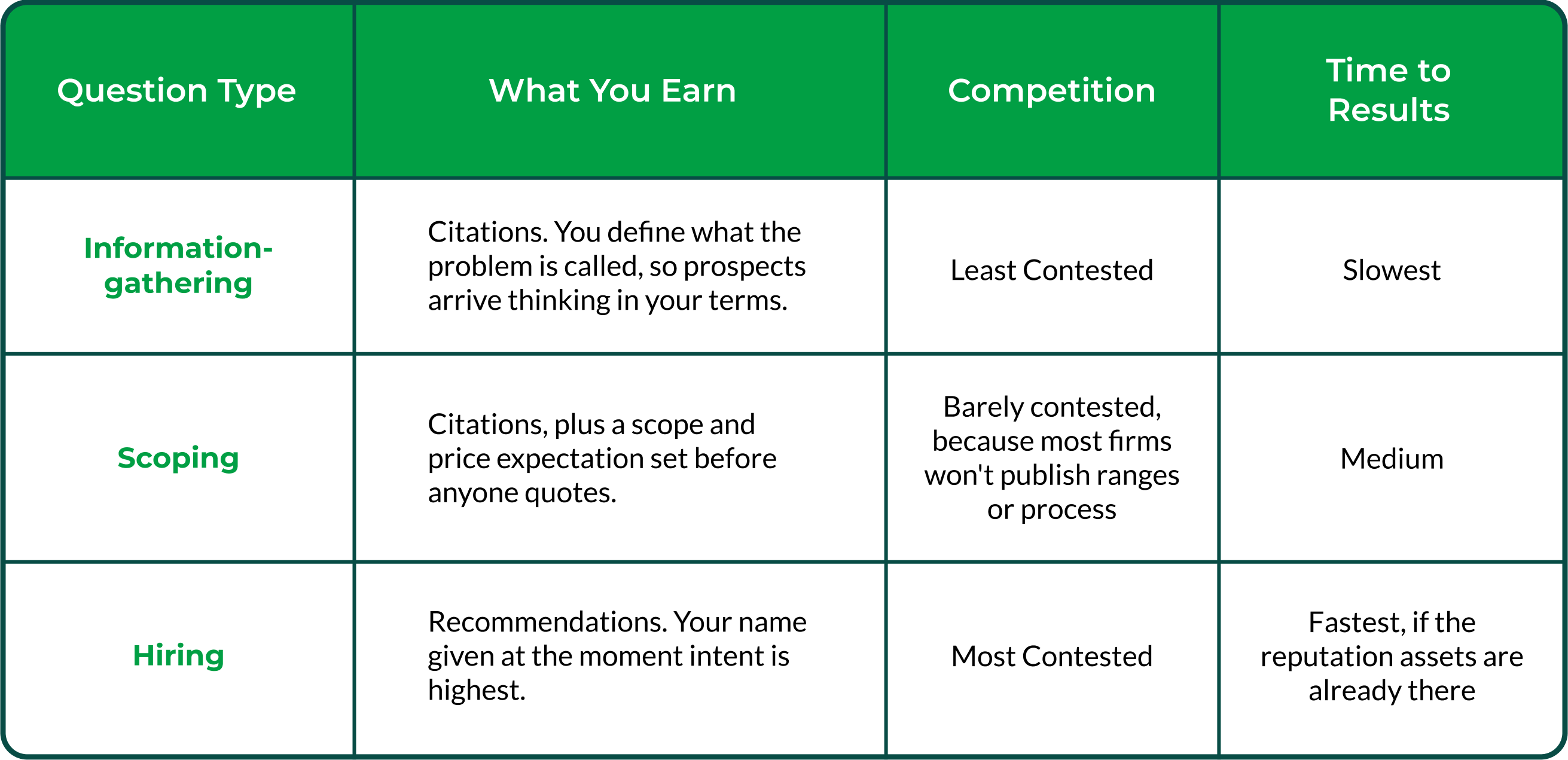
- Information-gathering. Do I need a fractional CFO? When should I hire an employment lawyer? Should I repair or replace my AC? Three different buyers, all at the same stage: not shopping yet, just working out whether there is anything to shop for.
- Scoping. What would fixing this involve? How long does it take? What should it cost? What kind of business handles this? They've accepted there's a problem, and now they want the shape of the solution.
- Hiring. Who's the best in my area? Which firm handles this kind of matter? Who should I call? Now they want a name.
Each type holds dozens of questions, not one. That is why a single page never covers a whole type. No matter who you sell to, these are the same three questions you probably answer on every sales call, depending on how much homework the person did first.
Where That Homework Happens Now
GEO changed how that homework gets done, and how much of it happens before a prospect ever fills out a form or dials a number. The initial question, the research, and the recommendation used to happen across a spouse, a colleague, and ten blue links. Now a good share of it happens inside one conversation with an AI tool that answers all three.
That shift wasn't gradual. BrightLocal's 2026 Local Consumer Review Survey found that 45% of consumers had used AI tools to find a local business in the past year, up from 6% the year before. That's consumer research rather than B2B, so read it as the leading edge: home services customers are further along this curve than professional services clients.
Your existing search performance doesn't automatically carry over, either. eMarketer's 2026 report on generative engine optimization reports that fewer than 10% of the sources cited by ChatGPT, Gemini, and Copilot appear in Google's top ten results for the same query. Performing well in traditional search and being cited by AI are different achievements.
Why Everyone Sells You the Hiring Questions
There's a reason nearly every conversation about AI visibility is about hiring questions: they're the only type that produces a number. A visibility tool can ask ChatGPT for the best accounting firm in your city, log whether your name came back, and hand you a score. That's clean. It fits in a report. It gives you something to react to.
So the industry sells what it can count. And if your score came back at or near zero, that's the expected result of being measured against the most contested of the three types, not evidence that you did something wrong.
Being Cited Isn't the Same as Being Recommended
Here's what a score like that can't tell you. There are two different ways to show up in an AI answer, and only one of them gets measured. A recommendation is when AI names your business as the answer. That's what hiring questions produce, and it's what every scan is testing for.
A citation is when AI builds its answer out of your material and credits you as the source. That's what information-gathering and scoping questions produce. Nobody asked for a provider, so nobody gets recommended. But someone's explanation is doing the work inside that answer, and it can be yours, with your name on it.
Designing content specifically to earn that is what WISE calls citation engineering: building pages so AI systems treat them as a source worth crediting. The scans miss all of it. They're looking for names in answers that were never going to contain one.
Where to Start When You're Starting From Zero
If none of this is set up at your firm, that's normal. You don't need all three at once. You need the one you can actually win, and that's decided by something you already know without any data at all: how much your prospects understand about their own problem before they contact you.
Here's how to tell which one is yours.
Start With Information-Gathering Questions If Your Prospects Don't Know They Need You
Information-gathering questions are the least contested of the three, which is exactly what makes them the strongest entry point from zero. A business owner wondering whether they need a fractional CFO can sit inside that question for half a year, and nobody is searching for your firm during those six months. They're searching for whether there's a problem. Very few of your competitors have published anything that answers it, because they're all crowded around the hiring questions instead.
The drawbacks are real. Information-gathering is the slowest of the three to show a measurable return. Some readers will also decide they don't need you, which looks like a waste right up until you notice those calls stopped landing on your calendar. What you get in exchange is staying power. A page that explains a problem clearly keeps getting retrieved long after a services page stops being new.
Start here if:
- Your sales cycle runs in months rather than days.
- What you sell is advisory, preventative, or planned rather than urgent.
- Your first calls get spent explaining what your service even is before anyone reaches scope.
Skip this type when the problem announces itself. Nobody asks ChatGPT whether they need a plumber when water is already coming through the ceiling.
Start With Scoping Questions If Price Is Where You Lose People
Almost nobody wants to compete here, which makes it the least contested type after information gathering. Most firms won't publish scope or price, and the reasoning makes sense: every matter is different, ranges get quoted back at you, and competitors read your website. But a prospective client trying to work out what an employment matter will cost is going to find an answer somewhere. It just won't be from you.
Scoping content has the strongest immediate payoff of the three: it pre-qualifies everyone who reaches you. When you publish your range and how the work actually runs, the person who reads it and clicks through has already accepted your numbers. They're not opening the conversation by shopping your price. They're starting from it.
The drawback is that this only works if you're willing to say things most firms keep inside a proposal.
Start here if:
- You can describe your process stage by stage.
- You can put a number on what the work typically costs, or at least an honest range.
- You can say how long it takes and what makes it take longer.
- You can name who you are not the right fit for.
Some prospects will rule themselves out on cost once you do. That is the filter doing its job, even though losing a lead never feels like progress.
Start With Hiring Questions If the Decision Happens Fast
Hiring questions are the most contested of the three and still sometimes the right place to begin, because most of what influences them already exists in some form. Your reviews, your listings, your Google Business Profile, your presence in the directories your industry actually uses. The work is consolidation rather than creation, which makes it the fastest of the three to move.
It's also where intent is highest. A hiring question is the shortest distance between an answer and a ringing phone. And because this is the one type that produces recommendations, progress shows up on the same scores everyone is already measuring.
The drawbacks are crowding and time. Hiring answers are largely decided by reputation assets that accumulate over years, so a firm thin on reviews and third-party mentions can do everything right and still lose the slot to a larger competitor. The other risk is staying here permanently. Once the phone is ringing, the constraint usually shifts to fit, and fit lives further upstream.
Start here if:
- Your prospects know exactly what they need and decide quickly.
- You do emergency or obvious-problem work where nobody needs educating.
- The constraint is simply capacity: a new office, a new service line, an associate with open hours.
You Don't Have to Pick Just One
Starting with one type isn't the same as only ever competing in one. A mature GEO strategy covers all three, because your prospect moves through all three.
Sometimes they arrive together. A homeowner's air conditioner quits on a Saturday in August. They ask ChatGPT whether a unit that age is worth repairing, and either that same answer or their very next message produces names. Answer the information-gathering question well, and you're standing right there for the hiring one. Even when the questions arrive weeks apart, being the source that explained the problem means the prospect has already met you once by the time they're choosing.
So pick the entry point that fits your business, then widen from there.
How You Actually Get There
Whichever type you start with, the work breaks into three pieces, and they depend on each other rather than sitting side by side on a menu.
Know Which Questions You're Missing From
Without that, every fix is a guess, and the guess defaults to hiring questions because they're the ones the tools measure. If you want the mechanics of how AI decides who to name, we covered that in how AI chooses which businesses to recommend.
Have Something Worth Citing
If nothing you've published answers the question a prospect brings to AI, there's nothing to retrieve. That's what content marketing does when it's aimed at real questions instead of a publishing calendar.
Make It Retrievable
Google's documentation calls this query fan-out: AI Overviews and AI Mode issue several related searches across subtopics instead of matching one query to one result. Ask whether to repair or replace an AC, and the AI may quietly also search typical lifespan, repair cost, and replacement cost. One visible question, several hidden ones, which is why covering a whole cluster gives you more ways to be found. That's the job of SEO and GEO.
Start Where You Can Actually Win
Not all three at once, and not whichever type a scan happened to measure. If you're starting from zero, the honest first move is usually the question your prospects open with rather than the one they close with. Which of the three that is depends on how much your prospects already understand before they call you. That's a question about your business, not about AI.
Worth saying plainly: nobody can guarantee AI will name you. Google's own guidance states there are no special requirements or markup for appearing in these features, and that serving is never guaranteed. The work is about removing the reasons to leave you out.
If you want a straight read on which type is worth entering first and what it would take to show up there, tell us about your situation. And if the answer turns out to be a tighter sales process rather than a content investment, we'll tell you that instead.
Share
Subscribe to WISE Insights
Stay ahead of the digital marketing curve and never miss a lucrative trend or insightful tidbit – subscribe to our WISE blog!
Keep Reading






Build. Grow. Soar.
Get WISE about digital marketing with advanced services, industry experts, and cutting-edge tools designed for long-term, sustainable growth.