It's Time to Get WISE.
 15-Minute Consultation
A quick, honest call to assess your needs and point you in the right direction—no sales pitch. Best suited for:
- Established businesses with a defined marketing budget
- Businesses prepared to grow and scale
 60-Minute Strategy Session
A deep dive with a top expert to uncover gaps and map a smarter path forward.
- Includes a $250 digital audit covering your website, SEO, local presence, and online performance—yours to keep.
- Get smart, actionable ideas you can apply to your business right away.
Enter the email you would like your guide sent to:
Enter the email you would like your guide sent to:
Enter the email you would like your guide sent to:
Apply Today
Please fill out the information below. Someone on our team will reach out in 3-5 business days to schedule a call if we see a good fit.
Book Patrick Dillon
Thanks for your interest in booking WISE CEO Patrick Dillon on your podcast! Please complete the form below, and a team member will contact you shortly.

Remove Negative Reviews.
When “More Leads” Isn’t the Goal—Better Leads Are


by WISE Digital Partners
April 2, 2026
- 18 min read

The math looks simple: if on average, only 1% to 5% of leads ultimately become clients, the path to more clients is more leads, right?
Not quite. Chasing volume means your team spends their days sorting through bad-fit inquiries, calling leads who were never going to convert, and watching qualified leads grow impatient as they wait for a response. Morale drops. Spend climbs. The pipeline fills with noise.
Smarter businesses flip the equation. Instead of optimizing for volume, they optimize for quality—leads who are genuinely aligned with their service offering, budget, timeline, and decision-making process. The result? Less time sorting, more time selling, and a pipeline that actually converts.
This article lays out a quality-first approach to digital marketing: how to attract leads with stronger intent, better fit, and higher readiness to buy.
Lead Volume vs Lead Quality—What’s The Difference?
Lead volume is the number of inquiries you generate. Lead quality is the likelihood that those inquiries will become clients.
The simplest way to think about lead quality is to map leads by where they are in the customer journey and understand what that means for their readiness to engage.
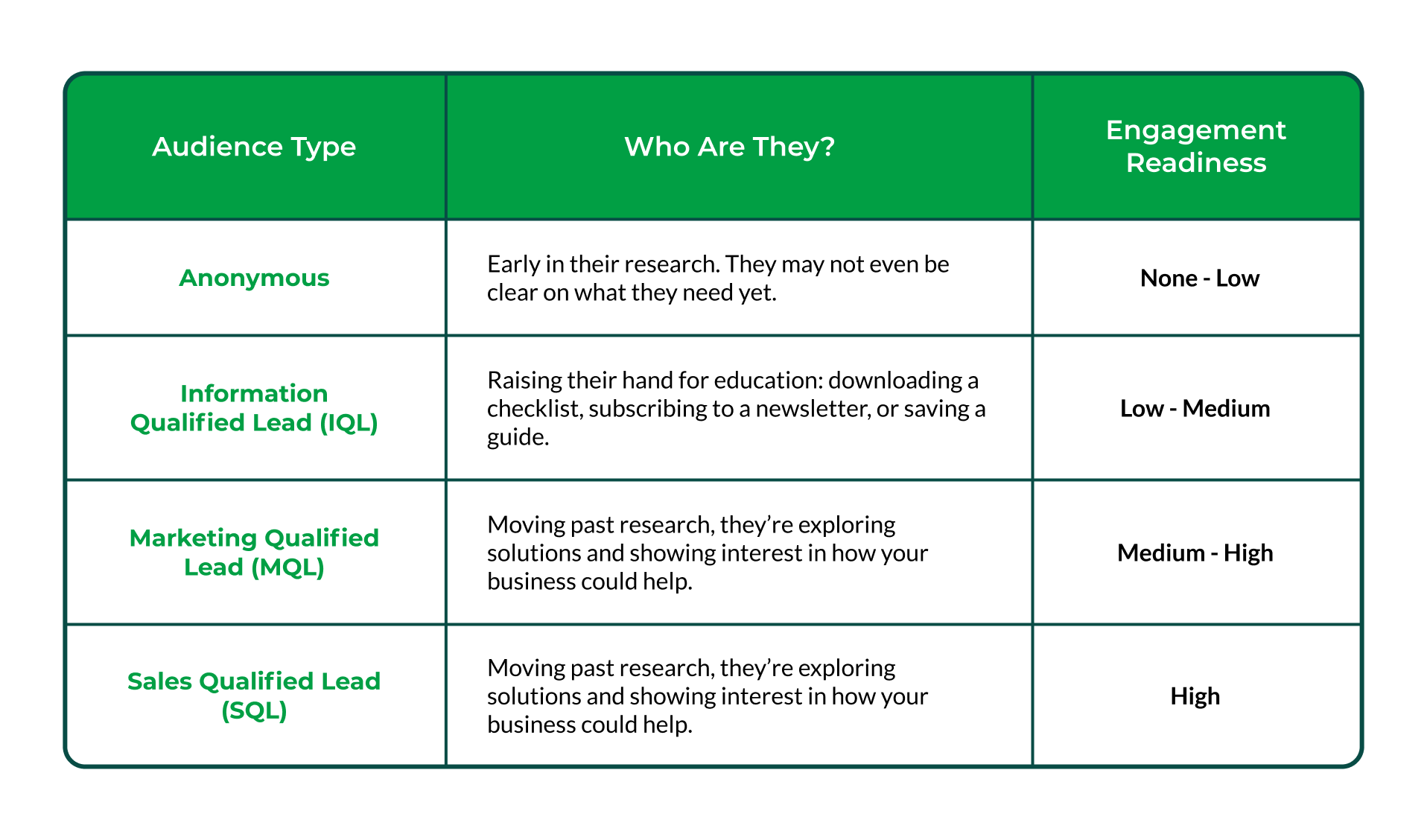
Unqualified leads show up early in the journey. Turning them into clients isn't impossible, but it takes time. More follow-ups, more education, more back-and-forth, turn into more chances for the lead to drop off before they convert.
The real cost isn't time. It's momentum. While your team is triaging low-readiness inquiries, response times slow for the people who are actually ready to buy. And high-intent leads don't wait long.
The best-qualified leads show three signals:
- Intent: they’re actively trying to solve the problem your business addresses.
- Fit: they match the type of client you serve profitably.
- Readiness: they’re prepared to make a decision now or in the near future.
When intent, fit, and readiness are high, ROI improves even if lead volume is lower. Your sales team spends less time persuading people who were never a match and more time guiding real buyers over the finish line, leading to shorter sales cycles, higher close rates, and a cleaner pipeline.
How Modern Buyers Discover and Evaluate Businesses
Buyers are researchers before they’re buyers. Before they ever fill out a form or pick up a phone, they're using digital sources to understand their needs, identify solutions, build a shortlist, and assess who they can trust.
That means you can influence the decision long before an inquiry lands in your inbox:
- Showing up in search results for the problems you solve signals relevance and earns you a spot on the shortlist.
- Consistent representation across key touchpoints—Google Business Profile, industry directories, review sites, social channels—reduces uncertainty and builds trust.
- High-quality content that answers the questions buyers are already asking helps leads evaluate fit, sets expectations, and moves the right leads closer to a decision.
AI-powered search tools are making that early research period easier and faster for buyers. Buyers can now get quick summaries, compare vendors, and narrow choices in minutes. That raises the bar: your visibility and positioning need to be clear enough that both humans and AI systems can quickly understand who you serve, what you do, and when you’re the right choice.
The takeaway isn’t to be visible everywhere; it’s to be visible to the right audience. Broad exposure increases unqualified leads, which slows response times for buyers who are actually ready to move. The goal is targeted discoverability: show up in the searches and channels your ideal clients use, with messaging that makes it easy for them to self-qualify before they reach out.
SEO’s Role in Attracting High-Intent Leads
SEO improves lead quality by putting your business in front of the right leads at the moment intent is highest: when they’re actively searching for a solution. Instead of optimizing for reach, a quality-first SEO strategy optimizes for relevance, targeting keywords that signal readiness and fit.
High-intent searches often include modifiers like "near me," "cost," "pricing," "consultation," "best," "hire," or a specific service and location. These queries signal decision-making, which is why they produce more qualified leads. Just as important, quality-focused SEO avoids broad, early-stage topics that drive traffic but not clients.
From there, SEO structures content for clarity, authority, and relevance. Well-organized practice-area or service pages make it easy for buyers to understand what you do, who it’s for, and what to do next.
Local SEO and service-area depth both attract qualified leads. Strong local signals help you show up for location-based searches that are closer to a purchase decision. Service-area depth helps you rank for specific needs rather than general categories.
As AI-powered search becomes central to early discovery, the same fundamentals apply: structured pages, consistent business details, and credible expertise signals make it easier for both traditional search and AI to interpret your offering and surface you for the right queries. Done well, SEO becomes a lead filter, not just a lead generator.
Not Just For Clicks: Paid Media As A Quality Filter
When paid media prioritizes lead quality, ad spend becomes its own qualification layer. The goal is to design campaigns so high-likelihood leads engage while bad-fit leads self-select out before they click. Deliberate targeting, intent signals, and messaging make that possible.
Paid media channels play different roles depending on buyer readiness—how close someone is to taking action. A quality-focused strategy matches search, display, and retargeting to the right stage of the intent funnel. You're not forcing early-stage researchers into a "book a consult" CTA or letting high-intent buyers fall through the cracks. This alignment improves lead quality by attracting leads whose needs, fit, and timing match what your sales process can actually convert.
- Search (high readiness | bottom of funnel): Reaches leads who are actively looking for a provider or next step right now. Prioritizing scenario- and service-specific queries (and excluding irrelevant ones) concentrates spending on buyers most likely to convert into qualified consults.
- Display (low-to-mid readiness | top/mid funnel): Targets relevant audiences who aren’t yet ready to engage. Lead quality improves when the display promotes credibility and education that nurtures intent and screens for fit before a sales conversation.
- Retargeting (mid-to-high readiness | mid/bottom funnel): Re-engages visitors who showed interest but didn’t convert—often because timing or confidence wasn’t there yet. Tailoring ads to the pages they viewed and offering the next logical step (FAQ, case example, consult screening) helps convert warmer, better-fit leads.
A well-honed paid strategy works hand in hand with strong SEO to improve your overall lead mix. SEO builds steady visibility over time, while paid campaigns let you be selective: expand coverage for priority services and locations, reduce wrong-fit inquiries with exclusions, and re-engage qualified visitors who weren’t ready to act. Together, they trade “more clicks” for more qualified conversations.
Content That Educates, Pre-Qualifies, and Builds Trust
Content strategy and copy improve lead quality by acting as a qualification layer before the first call. Instead of trying to appeal to everyone, strong messaging makes your ideal client profile obvious—which attracts higher-intent buyers and discourages bad-fit inquiries.
High-quality content also builds the trust required to move from research to decision. Guides, checklists, and explainers answer the questions buyers use to evaluate risk, competence, and credibility. The more your content mirrors real client scenarios and decision criteria, the more it attracts leads with the right problem and budget.
Content and copy improve lead quality by aligning calls to action with lead readiness. Early-stage visitors get low-friction next steps—download, watch, compare. High-intent visitors see direct actions (book a consult, request an assessment) with expectation-setting language around pricing ranges, timelines, required documents, and service boundaries. Over time, this creates a lead stream that's not just larger but better aligned with what your team can actually deliver.
Structured, authoritative content also improves discoverability in both traditional and AI-driven search. Clear headings, specific service/practice-area pages, concise definitions, and well-organized FAQs make it easier for search engines and AI tools to understand exactly who you serve and when you’re the right fit.
Conversion Rate Optimization (CRO): Turning the Right Traffic into the Right Leads
SEO and paid search make your business discoverable. CRO translates visibility into revenue by advancing high-fit visitors further into the customer journey and discouraging bad-fit inquiries before they fill your sales team's calendar.
The core lever is clarity. High-performing pages quickly communicate who your services are for, what problems you solve, and what a “good fit” looks like. When visitors can self-identify as qualified (or disqualified), you reduce bad-fit leads, increase conversions from the leads you actually want, and improve downstream quality.
Expectation-setting is the next clarity filter. Clear language about your process, timelines, pricing approach, required information, and engagement boundaries prevents bad-fit leads from raising their hand. At the same time, it builds trust with serious buyers by reducing uncertainty and signaling competence. The leads who do convert are more likely to be ready, informed, and worth a sales conversation.
CRO is a process of refinement. It closes the loop on clarity by measuring not just who converts, but who converts well—tracking lead quality by source and page, and weighting outcomes like qualified consult rate, sales acceptance, close rate, and revenue per lead. When a page drives plenty of submissions but low acceptance, that’s a clarity problem: the messaging is attracting the wrong leads or failing to set expectations.
Over time, those signals tell you exactly what to adjust—your "good fit" language, pricing and timeline guidance, form questions, and page structure—so you can improve the levers that turn leads into clients without simply inflating lead volume.
AI Discoverability: How Quality Shapes Visibility
AI-driven discovery rewards businesses that send strong quality signals. AI tools match a user's question to a provider worth recommending, and they rely on three basics:
- Relevance: Do you clearly offer what the user needs in the right context?
- Authority: Are you credible and verifiable?
- Clarity: Can your site be interpreted accurately without guesswork?
When positioning is vague or inconsistent, you’re less likely to be surfaced or, worse, you’re surfaced for the wrong queries, which produces low-quality leads.
That’s why focused messaging performs better in AI-powered search. Specialization reduces ambiguity: it’s easier for systems to understand what you do, who you serve, and what “good fit” looks like. Instead of “full-service” generalities, clear practice-area definitions, client-type boundaries, and scenario language (the problems you solve) help map intent to fit, so that the leads who find you are more likely to be aligned and ready.
Structure makes those signals easier to extract. Well-organized FAQs, explicit service definitions, and consistent business details help AI tools summarize accurately and reduce misinterpretation around key terms such as scope, location/jurisdiction, and process. And when content and UX reinforce the same message—clear navigation by practice area, scannable headings, plain-language summaries, proof points near decision moments, and readiness-matched next steps—you make it easier for both humans and machines to reach the right conclusion: who you’re for, and what to do next.
Why Lead Quality Requires Different Services at Different Growth Stages
Lead quality isn't static—it evolves as your business matures. A company just establishing market presence has fundamentally different lead quality needs than one scaling an already-proven service offering. The mistake most agencies make? Applying the same playbook regardless of where the business actually is.
Early-Stage: Building Clarity, Foundation, and Visibility
At this stage, the work is foundational. You're clarifying positioning, defining your ideal client, and building the infrastructure that makes lead generation possible in the first place. That means a conversion-optimized website, local SEO to establish visibility, and content that articulates what you do and who you serve. Without this foundation, driving more traffic—paid or organic—just exposes the cracks faster.
The priority isn't volume. It's clarity. Does your website communicate who you help and how you help them? Can leads find you when they search for the services you offer? Do you have the trust signals—testimonials, case studies, clear positioning—that close the gap between "I found this firm online" and "I trust them enough to reach out"? If the answers are no, more leads won't solve the problem. A stronger foundation will.
Growth-Stage: Refining Targeting and Messaging
Once the foundation is in place and you're generating consistent lead flow, the focus shifts to refinement. You're testing messaging, narrowing targeting, and learning which acquisition channels deliver the highest-value leads. This is where SEO expands into topical authority building, paid media gets more sophisticated with audience segmentation, and content starts solving the specific problems your best clients are asking about.
You're no longer just trying to get found—you're optimizing for who finds you. Which search queries bring in qualified leads versus tire-kickers? Which ad audiences convert at the lowest cost? Which content pieces are earning the most engagement from decision-makers? The goal is to double down on what's working and cut what's not. Quality at this stage means precision: attracting more of the right people and fewer of the wrong ones.
Scaling-Stage: Optimizing Conversion and Lead Efficiency
At scale, efficiency becomes the priority. You're not just generating leads—you're optimizing cost-per-acquisition, improving lead-to-close rates, and ensuring your systems can handle volume without sacrificing quality. Conversion rate optimization becomes critical. Attribution tracking gets more granular. Content shifts toward nurturing and closing, not just attracting.
This is where the small optimizations compound into significant gains. A 2% improvement in conversion rate on a site getting 10,000 visitors a month is 200 additional leads. Reducing cost-per-lead by 15% while maintaining quality can free up tens of thousands of dollars in annual budget. The infrastructure you built early and refined mid-stage now needs to operate at peak efficiency—because the business depends on it.
How WISE Adjusts Service Mix Based on Business Maturity
This is why every WISE engagement begins with strategy, not a pre-packaged service bundle. We assess where your business is, what's already working, and what's holding you back—then we build the service mix that matches your growth stage.
An early-stage firm might need a website rebuild and foundational SEO before paid media makes sense. Why spend money driving traffic to a site that doesn't convert? A growth-stage firm might benefit most from content that builds topical authority and paid campaigns that test new audience segments. A scaling firm might need conversion rate optimization and attribution infrastructure more than another blog post.
We meet you where you are and build the plan that moves you forward. That's the difference between a vendor selling services and a partner solving problems.
How WISE Builds Quality-First Digital Marketing Strategies
Most agencies operate in silos—SEO lives in one bucket, paid media in another, content somewhere else entirely. The result? Tactics that compete instead of compound. At WISE, every channel feeds every other channel. That's not a tagline—it's how we structure every engagement.
Integrated Approach Across SEO, Paid Media, Content, and CRO
We build strategies where SEO, paid media, content, and conversion optimization work as a unified system. Paid media drives immediate traffic while SEO builds long-term visibility. Content fuels both—answering the questions leads are searching for while positioning you as the expert they trust. Conversion rate optimization ensures that traffic converts.
Every piece reinforces the others. When paid media shows us which messaging resonates, that insight informs content strategy. When SEO reveals high-intent search queries, we build landing pages optimized for those terms. When conversion data shows us where leads drop off, we adjust site architecture, calls to action, and trust signals to close the gaps.
The strategy compounds because it's designed to do so. A blog post isn't just a blog post—it's an SEO asset that ranks for valuable search terms, a trust-building piece that moves leads closer to contact, and a resource that reduces cost-per-lead in paid campaigns by pre-educating visitors before they click. That's what integration looks like in practice.
Data-Driven Optimization and Ongoing Refinement
We don't launch and walk away. Every campaign is monitored, tested, and refined based on performance data. Which pages convert best? Which ad copy drives the highest-quality leads? Which content pieces are earning citations from AI platforms like ChatGPT and Gemini? We track it, learn from it, and adjust.
The first version of a strategy is rarely the final version—it's the starting point for continuous improvement. A paid media campaign might perform well initially, but three months of data will reveal which audience segments deliver the lowest cost-per-acquisition and highest lead-to-close rates. We shift the budget accordingly. An SEO strategy might show that certain topic clusters drive significantly more qualified traffic than others. We expand content in those areas and deprioritize what's not moving the needle.
This is how the flywheel accelerates. Every month of performance data makes the next month smarter. Every insight feeds back into the system, improving targeting, messaging, and conversion simultaneously.
Transparency, Reporting, and Performance Insights
You'll always know what's working and why. Our reporting doesn't bury you in vanity metrics—it focuses on what matters: lead volume, lead quality, cost-per-acquisition, and ROI. For clients on NEST™, all of this lives in a single unified dashboard: rankings, traffic, conversions, and billing, all in a single view. No hunting across platforms. No confusion about what the data means. Just clear insights you can act on.
We also explain the "why" behind the numbers. If organic traffic increased 22% month-over-month, we'll tell you which content pieces are driving it and what search terms are responsible. If paid media cost-per-lead dropped, we'll show you which audience adjustments made the difference. Transparency isn't just about showing the data—it's about making sure you understand what it means and what we're doing about it.
Acting as a Strategic Partner, Not Just a Lead Provider
We're not a lead vendor handing off contacts and moving on. We're invested in your actual business outcomes—not just deliverable completion. That means we share what we're learning, explain the reasoning behind our recommendations, and evolve the strategy as your business grows.
Our client retention is 3.5x the industry average because we treat every engagement as a genuine long-term partnership. We're not optimizing for this month's metrics—we're building systems that compound over years. Your website becomes a stronger lead generation engine. Your SEO authority grows. Your paid campaigns get more efficient. Your brand becomes the trusted answer in your market.
Your success is how we measure ours. That's not a value statement—it's how we operate. When a client grows revenue by 45% annually or generates $1.3MM in new business from the systems we build together, that becomes proof of what's possible. We're not here to check boxes on a service agreement. We're here to help you win.
Conclusion: Better Leads Create Better Growth
Lead quality isn't just a marketing metric—it's a growth strategy. When you optimize for the right prospects rather than the most, everything improves. Your sales team closes more deals in less time. Your cost-per-acquisition drops. Your client relationships start stronger because expectations were set before the first conversation.
The businesses that win aren't the ones generating the most leads. They're the ones generating the leads that actually convert, stay, and grow. That's how you build sustainable revenue—not by filling the pipeline with noise, but by engineering a system that attracts the prospects you're built to serve.
Share
Subscribe to WISE Insights
Stay ahead of the digital marketing curve and never miss a lucrative trend or insightful tidbit – subscribe to our WISE blog!
Keep Reading




Build. Grow. Soar.
Get WISE about digital marketing with advanced services, industry experts, and cutting-edge tools designed for long-term, sustainable growth.