It's Time to Get WISE.
 15-Minute Consultation
A quick, honest call to assess your needs and point you in the right direction—no sales pitch. Best suited for:
- Established businesses with a defined marketing budget
- Businesses prepared to grow and scale
 60-Minute Strategy Session
A deep dive with a top expert to uncover gaps and map a smarter path forward.
- Includes a $250 digital audit covering your website, SEO, local presence, and online performance—yours to keep.
- Get smart, actionable ideas you can apply to your business right away.

Enter the email you would like your guide sent to:

Enter the email you would like your guide sent to:
Enter the email you would like your guide sent to:
Apply Today
Please fill out the information below. Someone on our team will reach out in 3-5 business days to schedule a call if we see a good fit.
Book Patrick Dillon
Thanks for your interest in booking WISE CEO Patrick Dillon on your podcast! Please complete the form below, and a team member will contact you shortly.

Remove Negative Reviews.
The SEO Risks of Generic Business Names: A Strategic Analysis


January 9, 2026
- 11 min read

Many founders treat naming as a purely aesthetic exercise, searching for words that sound professional, expansive, or descriptive. Yet a business name is also a critical technical SEO asset.
The biggest trap? Choosing a generic business name. That’s because you’re not just competing with other companies—you’re competing with the dictionary, Wikipedia, and how search engines interpret language.
At WISE Digital Partners, we take a strategic approach to naming, moving beyond subjective impressions to focus on objective technical realities.
Here’s why generic names struggle to rank—and how to choose a name that builds authority, visibility, and long-term search presence.
Why Generic Names Sabotage Digital Growth
To understand why generic names fail, we must look at how Large Language Models (LLMs) and search algorithms process information. Google’s primary goal is to organize the world's information into a Knowledge Graph—a database of "entities" (people, places, and things) and the relationships between them.
Definition: Entity Ambiguity
Entity Ambiguity refers to the inability of a search engine or AI system to distinguish a specific brand entity from a general topic or keyword concept. When a brand name is identical to a common search term, the algorithm defaults to the "general intent," burying the brand in search results.
The Brand Entity vs. General Topic Problem
The core of modern SEO is the distinction between "strings" (text characters) and "things" (entities). When a user searches for a distinctive name like "Nike," Google knows immediately that the user is looking for the entity (the shoe company).
However, if a law firm names itself "Justice Law Group," Google encounters a conflict. Is the user looking for the specific firm, or are they looking for a "group of laws regarding justice"?
Because the name lacks distinctiveness, search engines struggle to assign "Brand Authority" to the website or business. The algorithm cannot confidently anchor the business in the Knowledge Graph because the signal-to-noise ratio is too low. This results in the "Answer First" problem: Google will prioritize defining the term or showing a map pack of all lawyers rather than navigating to your specific homepage.
The "Sea of Sameness"
In high-stakes industries like Accounting, Law, Real Estate, Finance, even Dentistry, the temptation to use descriptive keywords in the business name is high. This leads to what we call the Sea of Sameness.
Consider a real estate brokerage named "San Diego Real Estate." The founders might believe this is smart because it matches a high-volume search term. In reality, this is a strategic error.
By naming the company "San Diego Real Estate," the business is voluntarily entering a cage match against:
- Zillow, Redfin, and Realtor.com: Billion-dollar aggregators that own the keyword.
- Wikipedia: Informational articles about the housing market.
- News Outlets: Reports on local housing trends.
You are treating your brand name as a keyword. In doing so, you force your homepage to compete for "informational" intent rather than "navigational" intent. You want users to find you, but you have named yourself after the topic.
The Google Maps Verification Issue
The risks extend beyond organic search rankings into Local SEO and Name, Address, Phone (NAP) consistency. Google Business Profile (formerly Google My Business) has strict guidelines regarding business names.
Generic names trigger spam filters. If you attempt to verify "The Roofing Company," Google’s automated systems often flag the profile for "keyword stuffing," assuming you are trying to manipulate the map pack rather than represent a legitimate legal entity. Even if verified, you face a constant battle of distinctiveness. If a user asks Siri or Google Assistant to "Call The Roofing Company," the voice assistant will likely list three different businesses and ask for clarification, introducing friction that costs you leads.
Case Study Analysis: Real-World Examples of Poor Naming
To illustrate the severity of this issue, we analyze common naming conventions that fail to generate Entity Recognition. These examples are real U.S.-based small businesses and highlight why specific formats struggle to gain traction in the Knowledge Graph.
Business Solutions, Inc.
- The Failure: Lack of Context.
- The Consequence: This name forces the user (and the search engine) to dig deeper to understand the industry. It ranks for nothing because it attempts to be everything. It creates zero semantic relevance.
Home Renovation Solutions
- The Failure: The "Keyword Stuffing" Fallacy.
- The Consequence: This sounds like a service description, not a company. In the SERPs (Search Engine Results Pages), this looks like a subheading on a competitor's blog post rather than a distinct brand.
The Roofing Company
- The Failure: Category Competition.
- The Consequence: This is a Local SEO nightmare. The business is competing with the category label itself. When users search "roofing company," Google shows a list of nearby roofers, not necessarily The Roofing Company.
Synergy Consulting
- The Failure: The "Buzzword" Trap.
- The Consequence: "Synergy" is one of the most overused terms in the corporate lexicon. It dilutes identity. Search results for this term are a mix of definitions, memes, and thousands of other consulting firms with the same name.
Great Smiles Dentistry
- The Failure: The "Cliché" Trap.
- The Consequence: While relevant, it is indistinguishable. It competes with general dental advice articles, product reviews for teeth whitening, and hundreds of other practices sharing the name.
The Hypothetical Pitfall: "Apex Global Strategies"
Let’s examine a hypothetical control example to demonstrate a common "corporate" naming error: Apex Global Strategies, which is also a real business name.
On the surface, this sounds professional and expensive. However, from an SEO perspective, it is invisible:
- "Apex": Apex is heavily used in USPTO registrations across multiple industries, which can make protecting a new brand with this name challenging.
- "Global": For an SMB, this implies a false scale. If you are a local financial advisor in San Diego, "Global" creates a trust disconnect and confuses local search algorithms that prioritize proximity.
- "Strategies": This lacks industry specificity. Are you in marketing, finance, or military logistics?
The result is a brand that sounds important but offers minimal semantic signals to search algorithms. That lack of clarity typically requires more time and budget to build visibility for your own brand name than a distinctive, descriptive brand like WISE Digital Partners, which we have trademarked across multiple digital marketing and marketing software classes.
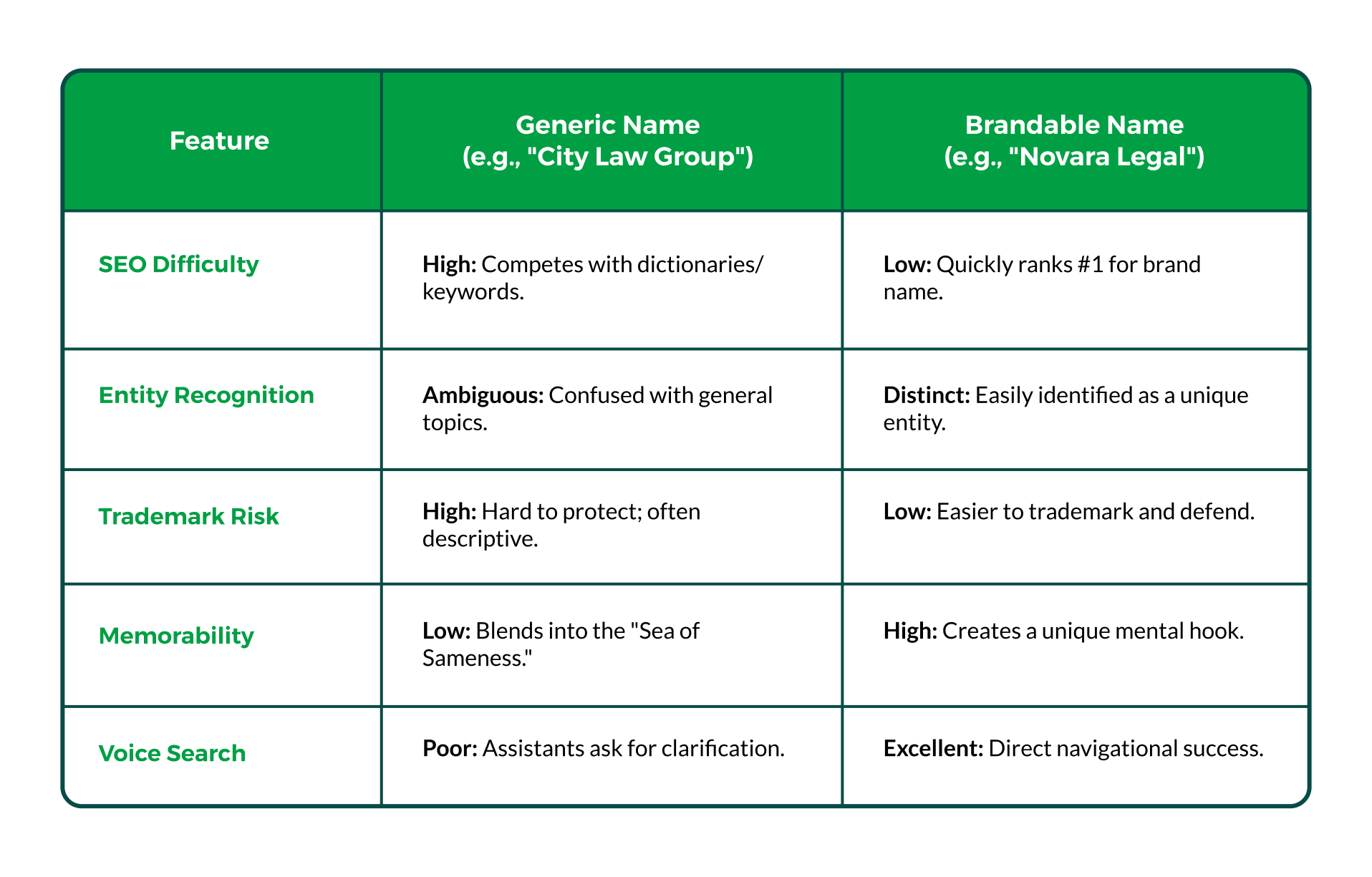
Generic Name vs. Brandable Name Comparison
The Protocol: How to Vet a Business Name for SEO
Before printing business cards or filing incorporation papers, a business name must pass a rigorous digital audit. At WISE Digital Partners, we utilize the following protocol to ensure a name is viable for search.
1. The "Radio Test"
If you say the business name on a radio advertisement, can the listener spell it correctly on the first try? If your name relies on a unique spelling (e.g., "Kreative Solutunz"), you are leaking traffic. Users will search the correct spelling and find your competitors.
2. The Google "Incognito" Check
Open an incognito window and search your proposed name.
- Red Flag: If the first page is filled with dictionary definitions, Wikipedia entries, or news articles about a general topic, abort.
- Green Flag: If the results are mixed or show low-authority pages, there is an opportunity to dominate.
3. The USPTO Search
Perform a preliminary search on the United States Patent and Trademark Office (USPTO) database. While we are not attorneys, from an SEO perspective, sharing a name with a litigious entity can result in trademark enforcement actions, cease-and-desist letters and domain disputes later.
4. The Domain Availability
Can you secure a clean .com without adding hyphens or filler words (like "get" or "try")? While new top-level domains, or TLDs (like .agency or .io), are gaining traction, a clean .com remains the gold standard for trust and direct traffic.
5. The "Zero-Click" Relevance
This is the sweet spot of naming. Does the name imply the industry without being a generic keyword?
- Bad: "Digital Marketing Agency" (Generic)
- Good: "WISE Digital Partners" (Implies partnership and digital services, but creates a unique "WISE" entity).
- Good: "Summit Financial" (Implies money management, anchored by a distinct brand name).
Transitioning from Generic to Distinctive (Strategic Rebranding)
Rebranding is not an admission of failure; it is a strategic pivot toward asset protection and growth. For established businesses in high-stakes industries like Law, Finance, or Real Estate, however, changing a name carries technical risks. It requires a precise SEO Migration Strategy.
Simply buying a new domain and building a new site will destroy your existing history. A proper transition requires:
- 301 Redirect Mapping: Telling Google that the old "concept" is now a specific "entity."
- NAP Updates: systematically updating every directory, from Google Business Profile to Yelp and industry-specific citations.
- Entity Association: Using schema markup to inform the Knowledge Graph that Organization A is now Organization B.
At WISE Digital Partners, we help clients preserve the brand equity they’ve built while systematically transferring it to a new name positioned for long-term growth and authority.
AI-Powered Naming: The Prompt That Gets It Right
Not sure where to start with naming or renaming your business? One of the fastest ways to generate smart, SEO-informed ideas is to use a well-constructed prompt with an AI tool like ChatGPT. But not just any prompt will do. You need one grounded in real search strategy, branding logic, and technical SEO standards.
We’ve distilled our entire naming protocol—The Radio Test, Incognito Check, Trademark Vetting, Domain Viability, and Zero-Click Relevance—into a single, powerful naming prompt. Use AI to spark ideas that align with SEO and branding strategy. Then apply human review and legal vetting.
The Prompt:
"Act as a brand strategist and SEO expert. I’m starting/rebranding a [describe your business, e.g., ‘boutique family law firm in Austin, Texas’]. Suggest 10 business name options that meet all the following criteria:
- Pass the 'Radio Test' – names should be easy to spell when heard aloud and free of intentional misspellings or confusing phonetics.
- Pass the 'Google Incognito Test' – names should not return results dominated by dictionary definitions, Wikipedia entries, or broad category content.
- Show strong trademark viability – aim for low conflict in the USPTO database and avoid highly saturated brand terms.
- Have domain availability – ideally, a clean .com without hyphens, unnecessary modifiers like 'get' or 'try,' or long strings.
- Offer zero-click relevance – the name should suggest the industry or service area without being a direct keyword match.
Give a short rationale for each name you suggest, focusing on search performance, memorability, and brandability."
Conclusion & Strategic Next Steps
Your business name is your very first SEO signal. It is the anchor text for your brand and the label for your entity in the Knowledge Graph.
If you choose a generic name, you are choosing to allocate a percentage of your marketing budget forever just to fight for visibility against your own name. You are paying a "generic tax" on every campaign.
Do not let subjective aesthetics override objective technical reality.
- If you are a startup: Vet your name against the protocol above.
- If you are an established brand struggling to rank: It may be time to audit your brand foundation.
Stop fighting the dictionary. Contact WISE Digital Partners in San Diego today for a brand audit and digital strategy consultation. Let us help you build a data-driven identity that commands authority and eliminates ambiguity.
Share
Subscribe to WISE Insights
Stay ahead of the digital marketing curve and never miss a lucrative trend or insightful tidbit – subscribe to our WISE blog!
Keep Reading




Build. Grow. Soar.
Get WISE about digital marketing with advanced services, industry experts, and cutting-edge tools designed for long-term, sustainable growth.