It's Time to Get WISE.
 15-Minute Consultation
A quick, honest call to assess your needs and point you in the right direction—no sales pitch. Best suited for:
- Established businesses with a defined marketing budget
- Businesses prepared to grow and scale
 60-Minute Strategy Session
A deep dive with a top expert to uncover gaps and map a smarter path forward.
- Includes a $250 digital audit covering your website, SEO, local presence, and online performance—yours to keep.
- Get smart, actionable ideas you can apply to your business right away.
Enter the email you would like your guide sent to:

Enter the email you would like your guide sent to:
Enter the email you would like your guide sent to:
Apply Today
Please fill out the information below. Someone on our team will reach out in 3-5 business days to schedule a call if we see a good fit.
Book Patrick Dillon
Thanks for your interest in booking WISE CEO Patrick Dillon on your podcast! Please complete the form below, and a team member will contact you shortly.

Remove Negative Reviews.
Why Marketing Strategy Beats Tactics Every Time


by WISE Digital Partners
July 29, 2026
- 8 min read
You have been told to invest in SEO. Then someone says PPC will get results faster. A conference speaker insists video is non-negotiable for your industry. Your competitor just launched a podcast. Meanwhile, everyone in your inbox is selling an AI tool that promises to automate the whole thing.
So you try a few things. You run Google Ads for three months. You hire a freelancer to write blog posts. You start posting on social media more consistently. Some of it shows a flicker of results. Most of it does not. So you try something else with a new platform, a new vendor, a new promise.
This is the tactic treadmill. It is the single most common pattern we see in established businesses that feel stuck, and it cuts across every industry. The accountant wondering why her firm's content is not generating leads and the plumber frustrated that his ads are not producing calls are experiencing the same underlying issue.
The problem was never choosing the wrong tactic. The problem is trying tactics without a strategy to connect them to. And in 2026, that gap between tactic and strategy has become more expensive and more urgent than ever.
Why 2026 Made the Problem Worse
The promise of digital marketing used to be simplicity: put your business online, and clients or customers will find you. In 2026, "being online" is not one thing. It is dozens of things, each with its own algorithm, best practices, and cost structure. Without a strategy to decide which of those things matter for your specific business, the promise becomes noise.
More Channels Than Ever
Five years ago, a business owner evaluating digital marketing had a relatively contained set of decisions: a website, Google Ads, maybe a social media presence, and perhaps a local directory listing. The options were manageable. The learning curve, while real, had limits.
Today, that same owner faces organic search, paid search, AI-powered search results, social search on TikTok and YouTube, local service ads, paid social across half a dozen platforms, email automation, and an expanding list of AI discovery tools where their business may or may not appear.
Each channel operates on different rules. Each rewards different content. Each demands time and budget to execute well.
AI Is an Accelerator, for Good or Worse
AI tools have made it faster than ever to create content and launch campaigns. That sounds like an advantage, and with the right foundation, it is. But for a business without clear strategic direction, AI accelerates the existing confusion. You can generate blog posts, ad copy, and social content at scale, but none of that helps if the message is unclear and the audience is undefined.
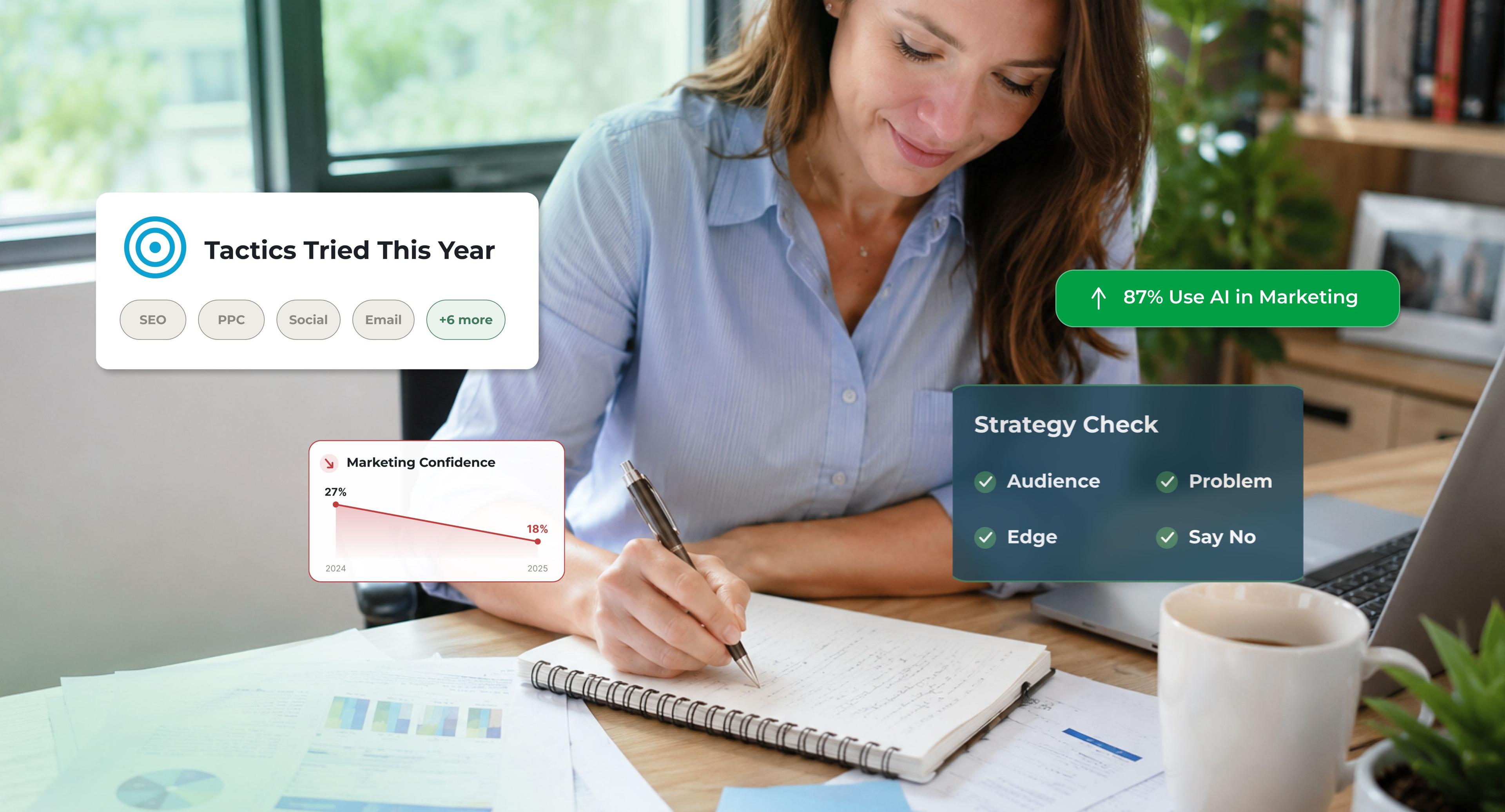
In the US alone, 87% of small businesses now use AI in their marketing, a figure that stood at just 26% three years ago. Yet confidence in marketing effectiveness has moved in the opposite direction. Only 18% of small business decision-makers described themselves as "very confident" their marketing was working, down from 27% the prior year.
AI gave businesses more output, not more direction. A new tool makes execution easier, but without a strategy guiding that execution, results disappoint, the tool gets blamed, and the business moves on to the next option. The real issue, the missing strategic foundation, never gets addressed.
What Strategy Actually Means
Strategy is one of the most overused words in business. It gets attached to slide decks, agency proposals, and planning documents that are really just dressed-up lists of tactics. A social media calendar is not a strategy. An SEO plan built around search volume is not a strategy. A marketing budget broken out by channel is not a strategy.
A strategy is the set of decisions that determine who you serve, why they should choose you, and how you reach them. Before any money gets spent or any tactic gets launched, four questions need clear answers:
- Who is the specific type of client or customer you want more of?
- What problem do you solve that they will pay real money to address?
- What makes you the right choice over the other credible options in your market?
- What are you deliberately choosing not to pursue?
That last question is the one most businesses skip. A real strategy requires saying no. If your plan targets every audience, promotes every service equally, and tries to maintain a presence on every platform, you do not have a strategy. You have a wish list. And a wish list does not survive contact with a real budget.
When those four decisions are made, every tactical question has a filter to pass through. When they are not, every tactic is a coin flip.
Same Tactic, Different Outcome
Take a landing page. Every agency can build one. But a landing page made without strategy can be worse than no landing page at all. It absorbs budget, creates the appearance of progress, and moves nothing.
Two accounting firms, both offering bookkeeping services, both ask their marketing partner to build a landing page. Firm A has decided to focus on growing practices that need to scale their back office. Firm B targets solo practitioners who are spending their weekends doing their own books instead of with their families. Here is what those two pages look like next to a third firm that skipped the strategy work entirely.
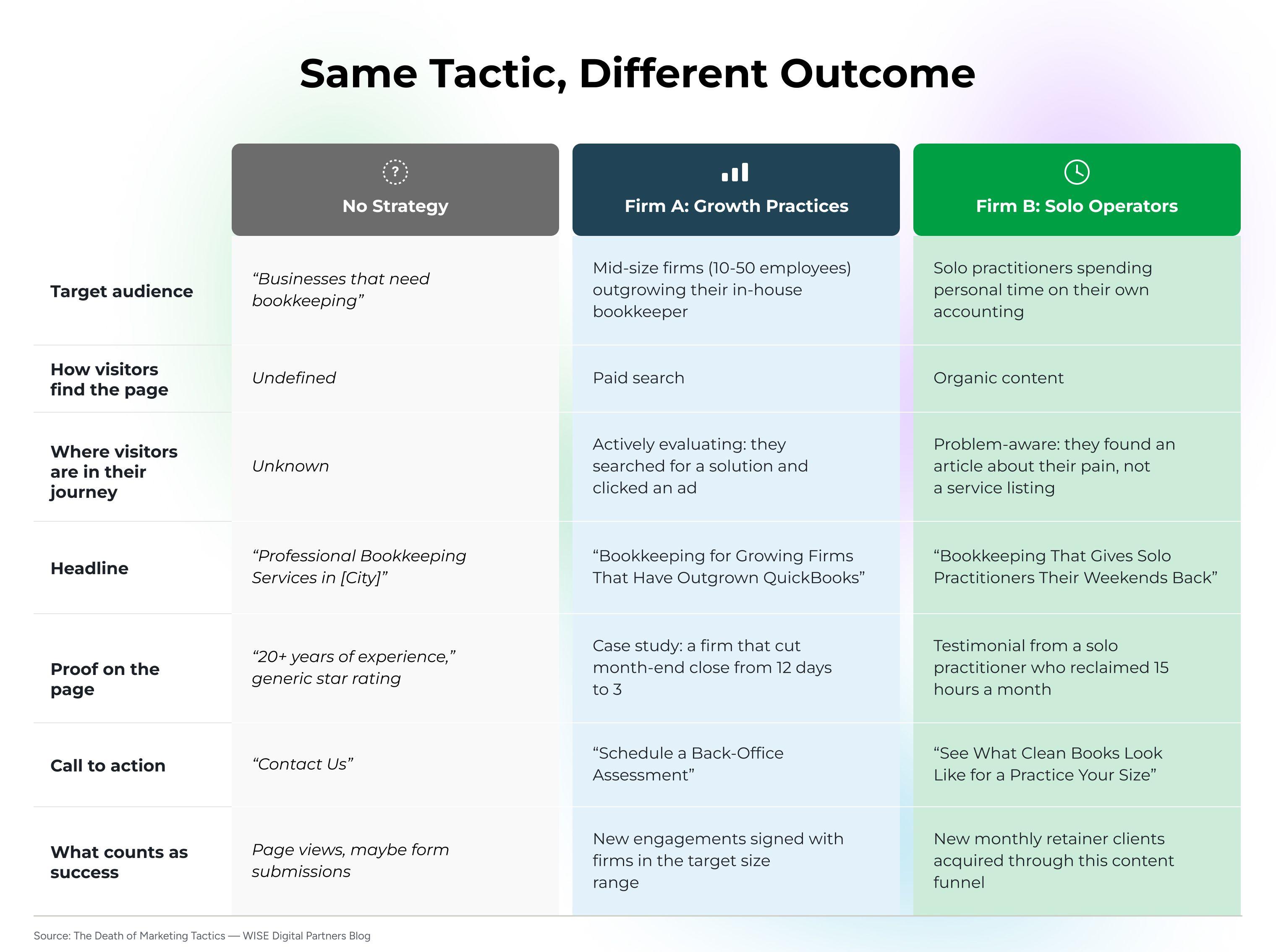
Three versions of the same landing page for the same service. The first speaks to everyone and persuades no one. The second and third speak to different audiences who arrive through different channels at different points in their decision. Both convert because every element, from the headline to the success metric, was shaped by strategic decisions made before the page was built.
There is no single correct strategy for a bookkeeping landing page. But any deliberate strategy outperforms having none.
This is the core of strategy-first. Strategy is not a separate phase you complete before the "real work" begins. It is the set of decisions that determines whether the real work produces results. Strategy-first means "know why before you act," not as philosophy, but as a practical discipline.
The Cost of Getting It Backward
Most businesses do not set out to operate without a strategy. They start with good intentions, pick a tactic that sounds promising, and plan to work out the bigger picture later. Later rarely comes. Instead, the tactic becomes the plan, and when it underperforms, the business switches to a different tactic. The costs of this cycle go deeper than most owners realize.
Wasted Spend Is Only the Visible Cost
The financial damage is the first thing businesses notice. A firm spends $4,000 a month on paid search, but the landing pages speak in generalities that could describe any competitor in any market. A contractor invests in content, but the topics were chosen based on what seemed popular rather than what the ideal customer needs to know before picking up the phone. The money moved. The results did not.
The spend does not have to be dramatic to accumulate. A $500-per-month social media tool here, a $2,000 PPC experiment there, a $3,000 website refresh that did not change the underlying message. Over 18 months, a business can easily spend $30,000 to $50,000 on disconnected tactics with nothing compounding to show for it.
We frequently see this pattern with businesses that have cycled through two or three marketing partners in as many years. Each partner executed competently. The ads ran. The content published. The reports arrived on time. Revenue did not follow. The common factor was never bad execution. It was the absence of strategic decisions that would have told any partner what to aim for.
How to Tell If You Have a Tactic Problem or a Strategy Problem
The tactic treadmill and a genuine tactic misfire feel identical from the inside. Both produce disappointing results. Both create frustration. But the fix for each is completely different, and choosing the wrong fix wastes more time and money.
Your problem is likely tactical if you can clearly describe who you serve and why they choose you, and your team gives the same answers. You have had some marketing success before. Some channels produce results while others do not. In that case, you have a strategic foundation. The issue is execution: the wrong channel, the wrong creative, the wrong targeting. Those are solvable with the right data and the right partners.
Your problem is likely strategic if you have switched marketing partners more than once without results improving. Your website could describe any of your competitors with minimal edits. Different people in your organization describe your ideal client or customer differently. You are not sure which channels deserve investment because you are not sure who you are trying to reach. Those are not execution failures. They are symptoms of foundational decisions that were never made.
Most business owners on the tactic treadmill arrived there by doing what made sense at the time. Recognizing the pattern is what lets you step off it.
Strategy First, Then Everything Else
The businesses that break out of the tactic treadmill are not the ones that find the perfect channel or the perfect marketing partner. They are the ones that stop long enough to define the strategy underneath. That usually takes less time than people expect. The four questions above are not a six-month project. They are a focused conversation.
Strategy-first does not mean "do less." It means "know why before you act." It means diagnosing before prescribing. It means being willing to hear that some of what you are currently spending on is not connected to where you actually want to go, and having the clarity to redirect those resources toward what is.
If any of this sounds like where your business is right now, that conversation is a good starting point. Not a sales pitch. A diagnostic. The goal is to figure out whether the challenge is strategic or tactical and to point you in the right direction, even if that direction is not toward us.
Share
Subscribe to WISE Insights
Stay ahead of the digital marketing curve and never miss a lucrative trend or insightful tidbit – subscribe to our WISE blog!
Keep Reading




Build. Grow. Soar.
Get WISE about digital marketing with advanced services, industry experts, and cutting-edge tools designed for long-term, sustainable growth.